

Options traders focus, often too much, on implied volatility to estimate the next change in option valuation. Is this always a wise policy? Options are derived from volatility in the underlying security (thus the term derivatives), a good question is: Why not focus on volatility trends in the underlying (historical volatility) to judge likely future valuation trends in options?
WE RECOMMEND THE VIDEO: Binary rise and fall 5 ticks 99.9% wining strategy 2019
Binary options warning: your capital might be at risk purchase win bot 100% so please mail me on olymptrader0007@gmail. Com bot price- $20 iq option ...
Traders trends to be absolute in their faithfulness. They might believe in tracking the Black-Scholes pricing model even with its well-known inaccuracy, or in calculating implied volatility even with its questionable and unknown quantity called “risk-free interest rate.” Anyone who disagrees with adherence to these methods is considered a heretic.
Another sect of the options faithful relies on underlying volatility to judge option valuation and also to time trades. This group looks for trends in historical volatility in order to time trades. Because volatility goes through cycles, with decreases following increases and vice versa, timing based on historical volatility is a reasonable tactic in deciding when to enter or exit trades.
The simplified “rule” is to sell options when volatility is high (because this also means option premium is rich) and to buy when volatility is low (because option premium tends to be depressed), so traders using timing based on historical volatility – assuming comparisons are made based on similar moneyness and expiration timing – is not unreasonable.
For example, look at how the Dow Jones Industrial Average (DJIA) has been behaving recently. The financial news announces the biggest-ever price drop in a single day, the loss of billions of dollars in market value, and the gut reaction of the market to economic news. But from a technical point of view, does any of this matter for the long term?
The Dow, we should remember, is not a singular market force, but the net of 30 different companies. These may move through volatility cycles in a similar and collective manner, as seen recently, but traders also have to remember the often observed reality: Volatility changes, but it also goes back and forth over a period of time. For example, look at the six-month chart for the DJIA.
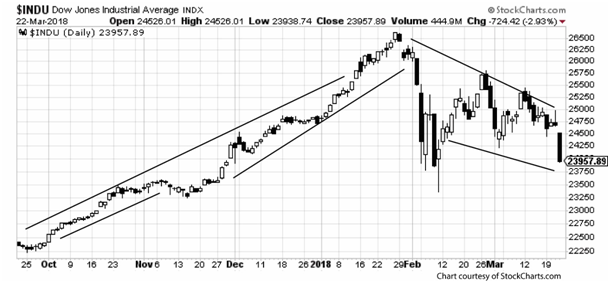
For the first four months shown on the chart, the channel was exceptionally narrow, and the price trend was remarkably consistent. Given that the value of the index is between 22,250 and 26,500 on this chart, the 500-point channel was remarkable over a four-month period.
The last two months presented a different story. The trading range was as high as 3,000 points and even when the early February volatility settled down, the bearish channel narrowed only slightly, with recent trading range about 1,250 points.
The change in volatility is noteworthy – and visible. For those traders deeply concerned about the “end of the trend” and the unexpected explosion in volatility, it is worth remembering that volatility itself is cyclical, just like price direction. These big moves over 1,000 points over only a few days is unlikely to continue indefinitely. Volatility will calm down once the impact of recent news is absorbed. The president’s decision to impose tariffs on Chinese imports is deeply concerning to the markets, but this economic news tends to have only short-term impact on volatility.
The news dominates equally important economic news including reduced tax rates, improved employment news, and much more. We also cannot know the outcome of the possible tariff war. Since it benefits no one, it could be that tariffs will be canceled with a revised trade agreement, and that the long-term impact on the markets will be positive rather than negative.
The situation at the moment, in which depressed stock prices have caused panic and retreat from the market among many institutions and individuals, is a passing volatility trend. The unending tendency to “buy high and sell low” (instead of the other way around) repeats itself time again. For options traders who are aware of the evolving nature of historical volatility, when the markets are unsettled as they have been in recent weeks, this presents an exceptional trading opportunity.
Options traders who consider themselves hedger rather than speculators, and who act as contrarians, will be able to recognize the opportunity this market presents. High volatility is “bargain-hunting season” for options traders, based on the easily observed changes in historical volatility.
What Is SteadyOptions?
Full Trading Plan
Complete Portfolio Approach
Diversified Options Strategies
Exclusive Community Forum
Steady And Consistent Gains
High Quality Education
Risk Management, Portfolio Size
Performance based on real fills
Non-directional Options Strategies
10-15 trade Ideas Per Month
Targets 5-7% Monthly Net Return
Recent Articles
Articles
Pricing Models and Volatility Problems
Most traders are aware of the volatility-related problem with the best-known option pricing model, Black-Scholes. The assumption under this model is that volatility remains constant over the entire remaining life of the option.
By Michael C. Thomsett, August 16

- Added byMichael C. Thomsett
- August 16
Option Arbitrage Risks
Options traders dealing in arbitrage might not appreciate the forms of risk they face. The typical arbitrage position is found in synthetic long or short stock. In these positions, the combined options act exactly like the underlying. This creates the arbitrage.
By Michael C. Thomsett, August 7
- Added byMichael C. Thomsett
- August 7
Why Haven't You Started Investing Yet?
You are probably aware that investment opportunities are great for building wealth. Whether you opt for stocks and shares, precious metals, forex trading, or something else besides, you could afford yourself financial freedom. But if you haven't dipped your toes into the world of investing yet, we have to ask ourselves why.
By Kim, August 7

- Added byKim
- August 7
Historical Drawdowns for Global Equity Portfolios
Globally diversified equity portfolios typically hold thousands of stocks across dozens of countries. This degree of diversification minimizes the risk of a single company, country, or sector. Because of this diversification, investors should be cautious about confusing temporary declines with permanent loss of capital like with single stocks.
By Jesse, August 6

- Added byJesse
- August 6
Types of Volatility
Are most options traders aware of five different types of volatility? Probably not. Most only deal with two types, historical and implied. All five types (historical, implied, future, forecast and seasonal), deserve some explanation and study.
By Michael C. Thomsett, August 1
- Added byMichael C. Thomsett
- August 1
The Performance Gap Between Large Growth and Small Value Stocks
Academic research suggests there are differences in expected returns among stocks over the long-term. Small companies with low fundamental valuations (Small Cap Value) have higher expected returns than big companies with high valuations (Large Cap Growth).
By Jesse, July 21
- Added byJesse
- July 21
How New Traders Can Use Trade Psychology To Succeed
People have been trying to figure out just what makes humans tick for hundreds of years. In some respects, we’ve come a long way, in others, we’ve barely scratched the surface. Like it or not, many industries take advantage of this knowledge to influence our behaviour and buying patterns.
- Added byKim
- July 21
A Reliable Reversal Signal
Options traders struggle constantly with the quest for reliable reversal signals. Finding these lets you time your entry and exit expertly, if you only know how to interpret the signs and pay attention to the trendlines. One such signal is a combination of modified Bollinger Bands and a crossover signal.
By Michael C. Thomsett, July 20
- Added byMichael C. Thomsett
- July 20
Premium at Risk
Should options traders consider “premium at risk” when entering strategies? Most traders focus on calculated maximum profit or loss and breakeven price levels. But inefficiencies in option behavior, especially when close to expiration, make these basic calculations limited in value, and at times misleading.
By Michael C. Thomsett, July 13
- Added byMichael C. Thomsett
- July 13
Diversified Leveraged Anchor Performance
In our continued efforts to improve the Anchor strategy, in April of this year we began tracking a Diversified Leveraged Anchor strategy, under the theory that, over time, a diversified portfolio performs better than an undiversified portfolio in numerous metrics. Not only does overall performance tend to increase, but volatility and drawdowns tend to decrease:
Saturday, January 20, 2018